 PRECISION
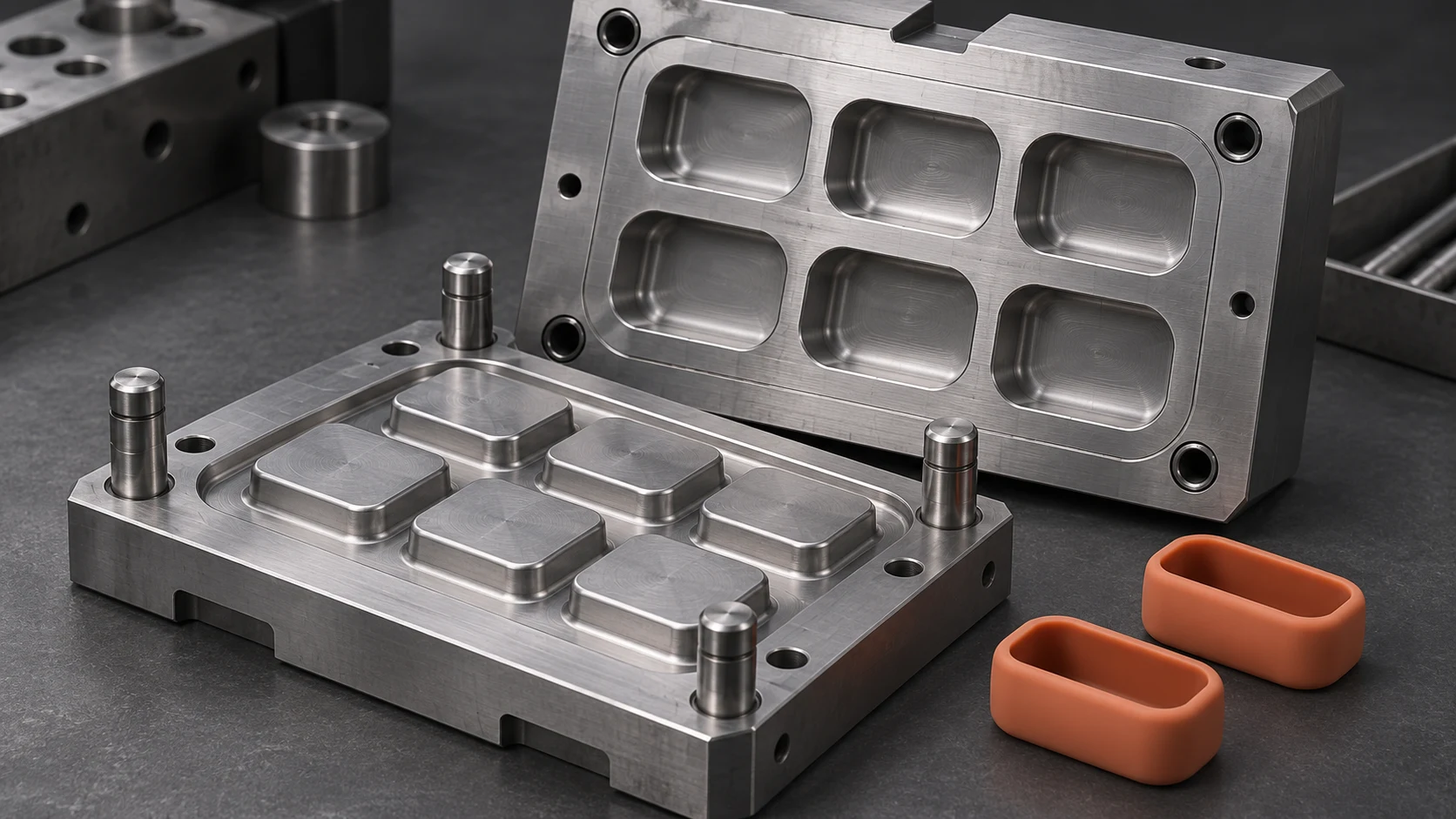
Choose cavity count from the required output, available press, part handling and verified production assumptions. More cavities can increase parts per shot, but the best commercial choice depends on the entire operating cycle and usable yield.
Start with required output
State both the first order and the expected recurring demand. A prototype decision and an ongoing production decision may justify different tooling investments. Ask which demand assumptions support the proposed cavity count.
Create a scenario rather than relying on an advertised cycle. Expected good parts per hour can be estimated as cavities × completed shots per hour × good-part yield. All three inputs need validation; this planning equation is not a production promise.
Include every part of the cycle
For a manual workflow, discuss material preparation, loading, curing, opening, removal, trimming and inspection. A larger mold may change the handling work as well as the number of parts formed. Ask whether the quoted output includes these steps.
Where inserts or delicate features are involved, handling can become an important part of the review. A capacity estimate is useful only if it reflects the actual staffing and workflow planned for the order.
Check the machine and layout together
| Decision | Question to ask |
|---|---|
| Press fit | Does the proposed layout fit the agreed installation interface? |
| Part handling | Can operators load and remove the parts as planned? |
| Consistency | How will trial samples be identified by cavity? |
| Maintenance | How are cavity-specific wear or damage issues addressed? |
| Economics | What changes in mold investment, operating cost and lead time? |
Request drawings or a layout discussion before treating a suggested cavity count as final. An equipment model name does not substitute for interface information.
Request two justified alternatives
Ask for a smaller and a larger configuration when both are feasible. Compare tooling cost, expected operating assumptions, trial scope and the conditions needed for each to make commercial sense.
Do not maximize cavities simply because the mold can be made larger. Choose the alternative that matches your realistic demand and the production setup you can support. If demand is uncertain, make the uncertainty visible in the decision instead of hiding it behind a single annual forecast.
Common questions
Will doubling the cavities halve the part cost?
Not necessarily. Loading, removal, finishing, yield and the proposed operating setup may change.
Should every cavity be checked during trial?
Agree on a cavity-identification and sampling plan appropriate to the part and project. Do not assume that one anonymous sample represents the whole mold.
Basis & further reading
This is an original procurement and project-planning guide. It outlines questions to agree with a tooling supplier; it does not state validated WYD production results or universal mold specifications.
Prepared for this website review on 18 November 2026. Project-specific technical review is required before manufacturing.
Turn the questions into a project brief.
Capture your material, drawings and tooling requirements in one place.
Prepare your brief